
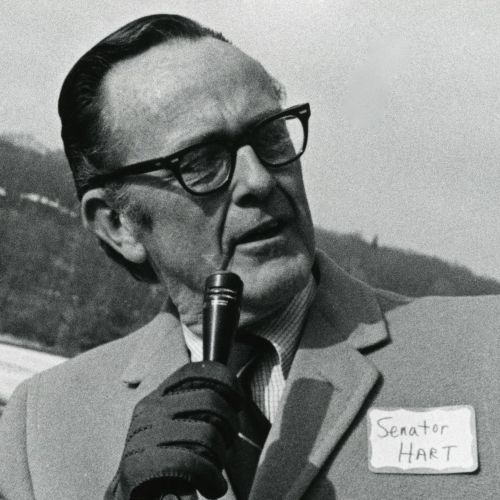
Some of the messages were handwritten on lined paper or stationery with deckled edges, while others were telegrams delivered by Western Union. Most were from constituents in Michigan, but some came from people in other parts of the country. Some were just a few sentences, while others stretched in cursive across five notebook pages.
“[I]t appears that the voting rights bill is an unnecessary piece of legislation. According to the less frenzied analyses which have appeared in the press there is sufficient existent legislation to assure the voting rights of any qualified citizen, without the newly proposed voting rights bill,” wrote one R. Cash of Dearborn, Michigan, in March 1965.
“I urge you to fight this legislation. Don’t let the White House twist your arm; twist its arm instead,” wrote T. Reid, a former Michigan resident. M.E. Vinton of St. Louis telegrammed, “Please delete vindictive, punitive ex post facto voting rights bill which would divide our country.”
Not everyone felt that way. “To protect everyone, we need a strong voting bill,” wrote R. Dornan of Detroit. “Want you to know you have our full moral support in the present civil rights crisis,” said one telegram from a reverend in Center Line, Michigan.
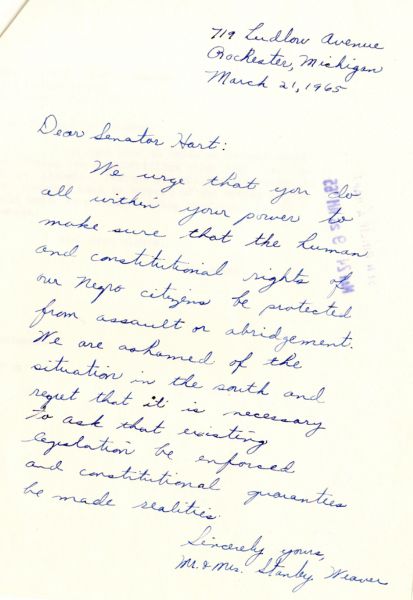
Letter from the Phil Hart collection.
Those letters, which can be found in the Bentley Historical Library’s Philip A. Hart papers, paint a picture of the pressures that the senator from Michigan faced in 1965. For Hart, nearing the end of his first Senate term, it proved to be just as pivotal a time in his career in public office as it was for the nation.
It was the year of the Selma to Montgomery marches in Alabama in which activists demonstrated to highlight racial injustice. At the first protest, on March 7, state troopers, sheriff’s deputies, and a sheriff’s posse attacked unarmed protesters with batons and tear gas on the Edmund Pettus Bridge. They beat one of the organizers unconscious, and a photo of her lying on the bridge was shared in the news media around the world. The day would become known as Bloody Sunday.
A second march two days later was cut short by Dr. Martin Luther King Jr. in response to a court order. That night, white supremacists murdered a white pastor who was participating in the marches. A third march was protected by the Alabama National Guard under federal control, along with the FBI and federal marshals, because segregationist Gov. George Wallace refused protection for the protesters.
The fallout from the events in Alabama, particularly the photo and the murder, spurred President Lyndon B. Johnson to accelerate his plan for getting a Voting Rights Act signed into law, something that required quick action in the House and Senate. Hart, a liberal Democrat with many friends on both sides of the political aisle, was asked to be the floor manager—the senator who would help to advocate for passage, coordinate amendments and debate, and shepherd the bill toward passage.
With Selma fresh in the minds of politicians and the public, Hart and his colleagues knew they had a good chance at passing the bill. The letters in Hart’s Bentley collection reflect the national mood, such as this one:
“There are miniature Wallaces and Selmas all through our country,” J. E. Hazen of Southfield, Michigan, wrote to Senator Hart. “The solution of many of these problems is obviously going to make many changes that greedy, power-hungry, or stupid people won’t like. . . . If you haven’t the courage to do this now, you don’t deserve to represent anyone.”
The Road to the Senate Floor
Philip Aloysius Hart was born in Pennsylvania, graduated from Georgetown University, and then earned his juris doctor from the University of Michigan Law School. He was married to Jane Hart (née Briggs), the first female helicopter pilot in Michigan. Jane would go on to qualify in the 1960s as one of the Mercury 13, a pioneering group of women who underwent the same physical and psychological tests as NASA’s male Mercury astronauts, proving women were qualified for spaceflight.
The couple lived in the Detroit area, where he practiced law until serving in the U.S. Army during World War II. Hart was wounded during the D-Day invasion of Normandy when shrapnel pierced the inside of his right arm. While recovering at the Percy Jones Army Hospital in Battle Creek, Michigan, Hart met fellow veterans Bob Dole and Daniel Inouye, both also future U.S. senators.
Hart, now a Purple Heart and Bronze Star Medal awardee, returned to Detroit, where he practiced law, then served as the politically appointed Corporation Securities Commissioner for the state. He was appointed U.S. Attorney for the Eastern District of Michigan, then served as legal adviser to Governor G. Mennen “Soapy” Williams, a law school classmate.
Hart was elected in 1954 as Williams’ lieutenant governor. In 1958, he ran for and was elected to the U.S. Senate, where he would make a name for himself as “a steadfast advocate for the common man,” according to a U.S. Senate biography. He supported the 1964 Civil Rights Act, and he remained a popular figure in Michigan even while conservative opponents tried to have him recalled for his stances on gun control, no-fault insurance, and integration of schools through busing (“Recall cures Hart attacks,” read some bumper stickers in support of the unsuccessful effort).
In 1965, President Johnson began the year with his “Great Society” proclamation during his January State of the Union address. The Selma marches followed two months later, and then the accelerated push for voting rights legislation to pass Congress.
The voting rights measure would provide for federal intervention to enable African Americans to register and vote. It had 66 sponsors in the Senate, but Hart still had his work cut out for him. While he was receiving letters from constituents, he was also trying to gain support for amendments such as one that would allow the attorney general to challenge the use of poll taxes in state and local elections (they were abolished in national elections the previous year).
The quick timeline meant that amendment designed to strengthen the bill had to be added in just a couple of weeks. The bill also faced a filibuster by Southern Democrats on the Senate floor, which required a two-thirds majority to overcome.
Ultimately, the bill passed 77 to 19—an astonishing majority, especially when viewed through the lens of today’s slim margins in many congressional votes. Disagreements arose between the Senate and House versions, between Southern Democrats and liberal Democrats, and between southern Democrats and moderate Republicans.
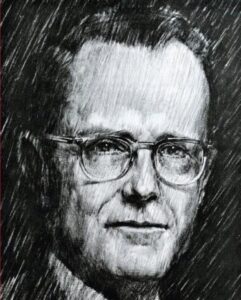
Sketch of Phil Hart from The Dignity of Man, 1965, by WXYZ Radio.
Hart helped to smooth over disagreements and build bridges. “His mere presence on the floor could sway votes,” one senator said, according to a Public Affairs Quarterly article titled “Virtue and Politics: The Example of Philip Hart.”
On August 6, 1965, President Johnson signed the Voting Rights Act, which he would describe as “a triumph for freedom as huge as any victory won on any battlefield.” The act was meant to ensure that states follow the 15th Amendment’s guarantee that the right to vote not be denied because of race.
The Voting Rights Act ’s effects were far-reaching, and it immediately helped to counteract the voter suppression of the Jim Crow South. By the end of 1965, just months after President Johnson signed it into law, a quarter of a million new Black voters had been registered to vote. In the South, most states had more than 50 percent registration of African Americans by the end of 1966.
In Alabama, the state where marches led by civil rights leaders caught the national attention, the percentage of adult African Americans registered to vote rose from about 19 percent in 1964 to more than 61 percent five years later.
In the middle of it all was Hart. Senate Majority Leader Mike Mansfield wrote this in a letter, now archived at the Bentley, to his colleague in 1965: “Dear Phil, I do not know how historians will regard the legislative work of the 1st session of the 89th Congress. I do know, however, how I will remember this session for the rest of my days. It has been a deeply gratifying experience to work with you and all of the members of the Senate in the endeavors of the past few months. . . . And the cement which has bound us all together in this work has been the cooperation, courtesy, and the mutual restraint which have prevailed.”
The Conscience of the Senate
Hart continued to take on high-profile and often contentious issues during his 18-year Senate career. He was chairman of the Antitrust Subcommittee that challenged big business in favor of consumer protection, “even when it contradicted his own political interests,” says a Senate biography of Hart. “Senator Hart’s commitment to such causes earned him the moniker, ‘The Conscience of the Senate.’”
When viewed through a modern lens or even his own hindsight, his career was not unblemished. He once prosecuted people in Michigan who were thought to be Communists under the “Alien Registration Act,” for instance; he later said he regretted it and even supported Supreme Court decisions that struck down such laws. He had many friends in the Senate, including Dole, Inouye, and Sen. Ted Kennedy. He was well known for his friendships with political foes too.
“There are few men in the Senate with whom I disagree more, or have greater affection for,” Sen. Sam Ervin of North Carolina said of Hart in a Detroit Free Press profile.
Some of his contemporaries are better known today than Hart, but he made a lasting mark in a number of ways. One was the Senate office building that was named for him as he was dying of cancer in 1976, at age 64.
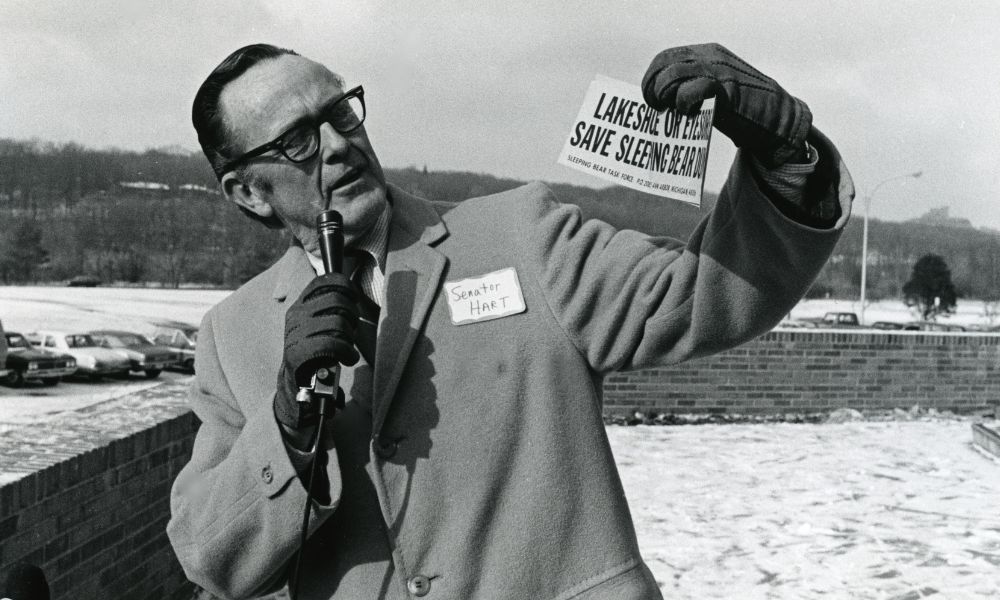
Senator Phil Hart holding a sign that says “Lake Shore Or Eyesore? Save Sleeping Bear Dunes,” from the News & Information photographs.
His name also is on the visitor center at the Sleeping Bear Dunes National Lakeshore in honor of his efforts to bring about legislation creating the federal designation for the lakeshore in the northwest Lower Peninsula of Michigan. Hart Plaza in Detroit is also named for him.
But it was the effort he put into passing the Voting Rights Act and the Fair Housing Act a few years later that he knew would make the most difference in people’s lives. Though he never made it to the age he predicted in this statement he made to the Detroit Free Press in 1969, the rest of the sentiment has stood the test of time: “When I’m 80 years old, a lot of towns are going to be different because of those bills.”