
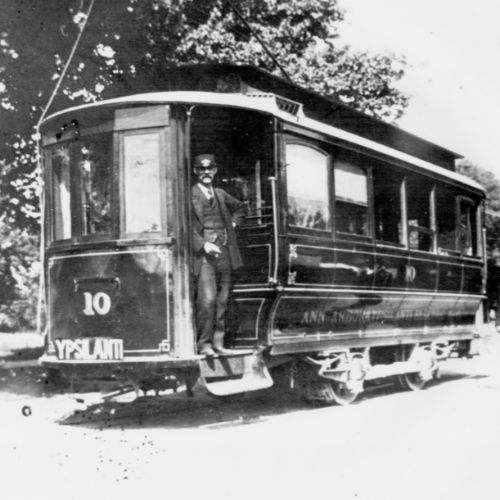
In the mid-1800S, travel between Ypsilanti and Ann Arbor was booming. Residents commuted by horse-drawn carriages to work in factories, attend college classes, or browse the newest shops.
With the arrival of rail lines and steam engines in the late 1800s, horses were soon replaced by horsepower. Developers built passenger cars pulled by steam engines, patterned after European suburban trains. For 5¢ for a one-way ticket, or 25¢ for six rides, passengers could sit back and enjoy the 30-minute trip between Ypsilanti and Ann Arbor.
The interurban trains were a hit, and developers soon tackled a bold next step: electrification. In 1896, the first electric streetcars hit the rails, operated by the Ann Arbor Railway. According to the book Electric Trolleys of Washtenaw County by H. Mark Hildebrandt and Martha A. Churchill, the electric trolleys, sometimes just called “interurbans,” were so popular that the rails were extended to Detroit in 1898. Ypsilanti remained the central trolley hub, favored in part by the existing train depots and rail infrastructure.
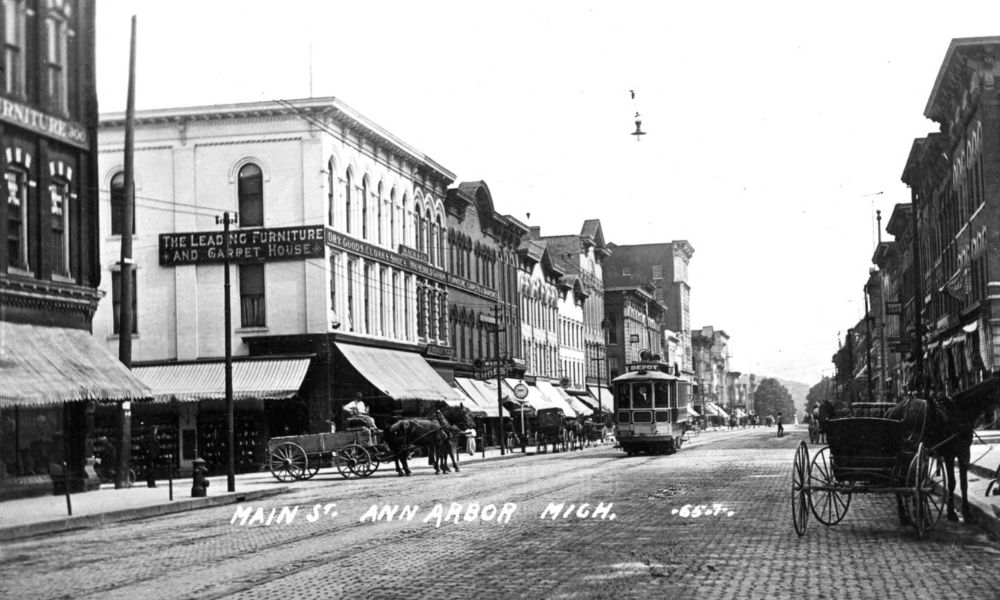
Electric streetcar on S. Main Street in Ann Arbor ca. 1908, Claude Thomas Stoner Photographs.
Rail companies soon envisioned expansion. In 1901, the city of Chelsea was seen as the gateway to westward expansion—and became the site of a major dispute. Two competing companies, a Detroit-based team vs. a Jackson resident, both started laying tracks through town, hoping to lay claim to the westward lines. In the end, the Detroit-based company took over and, by 1911, could connect cities that included Kalamazoo, Battle Creek, and Lansing.
The electric trolleys may have made travel convenient and inexpensive, but the routes were not without some risk. The rails danced in and out of roadways, increasing the likelihood of unfortunate meetings. Trolleys moving too fast around corners could jump off track, an especially worrying occurrence in a bustling city.
But the most perilous interactions were between trains themselves. Rails were often built on the side of the road on single tracks, with routes traveling in both directions. Like today’s rural highways, there were passing lanes every few miles, and train conductors did their best to follow the published schedule. One missed cue or a late arrival meant heavy, high-speed trains barreled towards each other without enough time to stop. Considering the potential for disaster, Hildebrandt and Churchill highlight that only four fatal collisions occurred between 1909 and 1929.
For a few decades, the promise of electric streetcars seemed unstoppable. However, the steady rise of the automobile created steep competition. In 1918, voters passed a $50 million bond to pave Michigan roads, further bolstering automobile travel. Faced with increasing taxes on rails, land, and buildings, along with decreasing popularity, the electric trolleys of Washtenaw County officially turned off their lights in the late 1920s.
Photographs of the trolley cars in their heyday can be found in several collections at the Bentley, including the Claude Stoner and Sam Sturgis papers