
Hi, Liz. Can you tell us more about what you do for the Bentley Historical Library?
I’m the Lead Archivist for Digitization Services, which means I oversee the work fulfilling imaging requests that come in from library users. Essentially, when someone wants a digital copy of something we have in our collections, they make a request that I help fulfill. This means the Bentley digitizes a wide variety of materials—like documents and maps and scrapbook pages and more— for all different types of library users.
There’s a new imaging lab for this kind of work. Can you tell us about it?
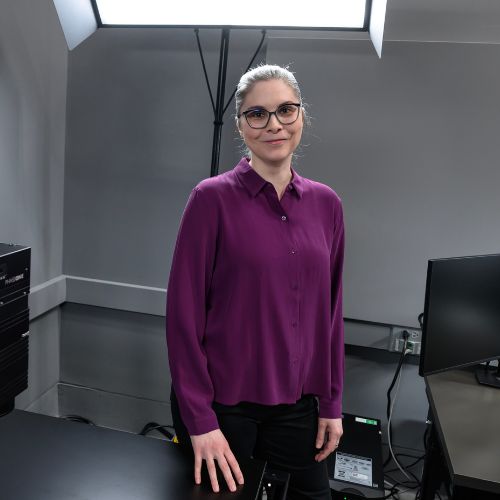
We have a new space at the Library’s offsite facility on U-M’s North Campus. It’s roughly 600 square feet with 16-foot ceilings. I designed the lab—from the neutral gray paint on the walls, to the specialty lights in the ceiling—to ensure we can capture originals as faithfully as possible and meet cultural heritage imaging guidelines. And there’s room for expansion, so we could have additional imaging equipment in the future to increase our capacity.
Speaking of capacity, what is the demand like for imaging right now?
Library users drive our demand. When I first started managing the imaging lab, we created about 10,000 files in the six months before the pandemic started. Demand doubled during the pandemic and current demand is our highest yet, nearly quadruple what I started with. So far, we have delivered 300,000 files in total to local, national, and international researchers.
What’s different about the technology in the new lab?
We have highly specialized, camera-based imaging equipment that is modular, which allows many different types of materials to be digitized. The new equipment is designed to handle everything from oversized items like architectural drawings, newspapers, and posters to more fragile items like glass lantern slides and tightly bound diaries. With a camera, it’s all instant capture, so it takes the same amount of time to digitize a letter as it does a large map.
Can you say more about how this work increases access to the library?
Not everyone has the time or resources to travel to the Bentley to look at our collections in person. We also recently implemented a new policy that lets library users get 250 pages of materials digitized for free. I like this work because we’re providing a core service and we’re providing it for free so there are fewer barriers to accessing our collections.
What are your favorite materials to work with?
Coming from a background in analog photography, I personally like working with slides and negatives even though they can be trickier to digitize. You’re handling media that is a physical representation of a fragment of time from the past but connecting with it in the here and now.