
In 1939, as the conflict in Europe metastasized into World War II, physicist J. Robert Oppenheimer penned a letter to George Uhlenbeck, a theoretical physics faculty member at the University of Michigan. In the letter, Oppenheimer discussed the newly discovered phenomenon called fission. He called it “bursting uranium” and hypothesized that it “might very well blow itself to hell.”
But in the letter, Oppenheimer also identified a problem: for this process to work, he wrote that “one should have something to slow the neutrons without capturing them.”
In other words, he needed something to slow down the neutrons just enough to allow the uranium to capture them, hold them, and cause fission—all without the neutrons being absorbed. But what?
Oppenheimer’s “something” turned out to be graphite.
Graphite became one of the keys to the success of the first atomic reactors in 1942 and, subsequently, the Manhattan Project, the massive effort led by Oppenheimer that created the atomic bomb and the nuclear age. Decades later, it was graphite that led researcher Walt Di Mantova (M.A. ’82) to the Bentley, where he did more than just deepen his knowledge of and connection to Oppenheimer; he also discovered some potentially unidentified—and scientifically valuable—Oppenheimer letters in the process.
Famous Physicists in Ann Arbor
Before Oppenheimer became a household name—and the title character, played by Cillian Murphy, of the 2023 blockbuster film—he was a promising young scientist. His friends called him “Oppie” and marveled at his myriad side interests, ranging from obscure languages to poetry to the culture of the American Southwest. And like many of his physicist colleagues, Oppenheimer visited Ann Arbor and the U-M Summer Symposia in Theoretical Physics.
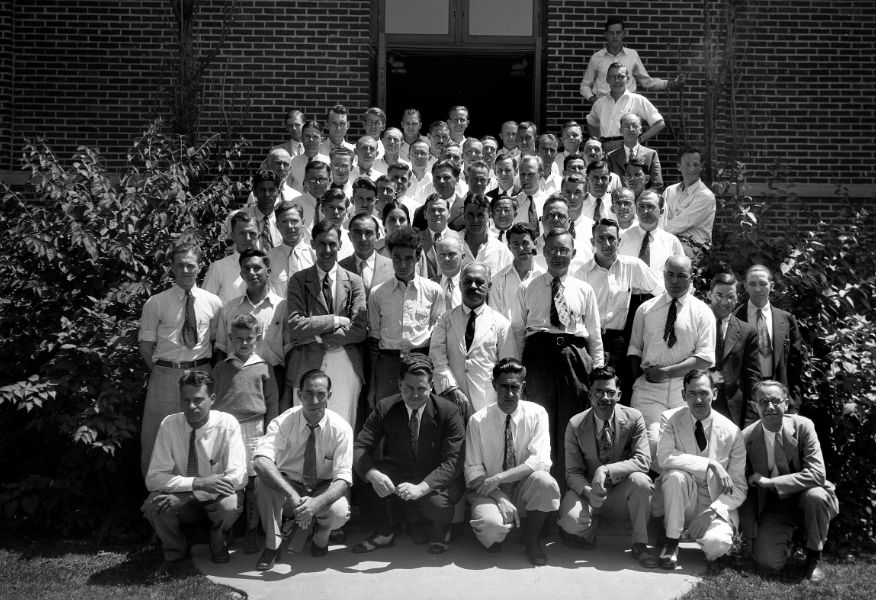
People attending UM physics symposium pose for group photo, Summer 1931, from the Ivory Photo photograph collection.
Under the guidance of U-M professors Harrison Randall, David Dennison, and Uhlenbeck, these symposia attracted scientists from all over the world, among them 15 past and future Nobel laureates, such as Niels Bohr, Werner Heisenberg, E. O. Lawrence, and frequent visitor Enrico Fermi.
Oppenheimer was a repeat attendee, visiting in 1928, 1931, and 1934, and during those visits he became close friends with Uhlenbeck and his wife, Else. Even when Oppenheimer couldn’t come to Michigan, he kept in touch with them, discussing everything from the weather to vacation plans. But mostly it was science, and the letters at the Bentley are bursting with equations describing positrons, neutrinos, and other particles that scientists discovered as they peered inside—and eventually split—the atom.
For example, Di Mantova was thrilled to discover a six-page letter from Oppenheimer to Uhlenbeck, dated April 1929, which is chock-full of dense, handwritten equations and musings. At the bottom, Uhlenbeck scratched a note in pencil:
“This is a very important letter showing that Robert had almost all aspects of [neutron] collision theory straight at a very early date.”
For Di Mantova, it was an unbelievable discovery, a “moment of holding incredibly important scientific history in your hands,” he says. And it was precisely this science that Di Mantova wanted to know more about, and its potential connection to his wife’s family—via physicists’ quest for graphite to slow down the neutrons.
Graphite Leads to Another Discovery
The biggest graphite producer in the country at the time was National Carbon with, among others, a large plant in Fremont, Ohio. In peacetime, the graphite they produced was used for batteries. But during WWII, Di Mantova says the company “secretly provided the graphite blocks used to not only create the first nuclear reactor but eventually to produce large amounts of uranium and plutonium.”
The head of National Carbon’s Fremont plant was George Warfield Armstrong, a University of Michigan graduate from the class of 1915. His granddaughter, Polly Paulson (M.P.H. ’82), is Di Mantova’s wife.
Inspired by Paulson’s connection, Di Mantova began to research more about what Armstrong did during the war. “He was proud of his contributions,” Paulson says. Family lore has it that, exhausted after the war, Armstrong retired young. “He left it all on the field,” Paulson says, and he was reticent about discussing his role. That left lingering questions about how directly Armstrong contributed to atomic work, what he knew about the Manhattan Project, or if he had a relationship with Oppenheimer or other scientists.
At the Bentley, Di Mantova was able to view Armstrong’s alumni file, where he discovered Armstrong was a chemistry major and a member of the Tau Beta Pi and Sigma Xi fraternities, as well as the Alchemist Society. After graduation, Armstrong served in the military, and went on to Hercules Powder, where he put his chemistry background to work making gunpowder and explosives. Not long after WWI ended, and only five years after graduation, he was running National Carbon in Fremont.
“Without the decision to use graphite in the first reactors and the availability of that very pure graphite, the United States would not have been able to produce the materials used in creating the first reactors and then atomic weapons,” says Di Mantova. “National Carbon, led by a University of Michigan alum, helped us win WWII and usher in an era of nuclear danger.”
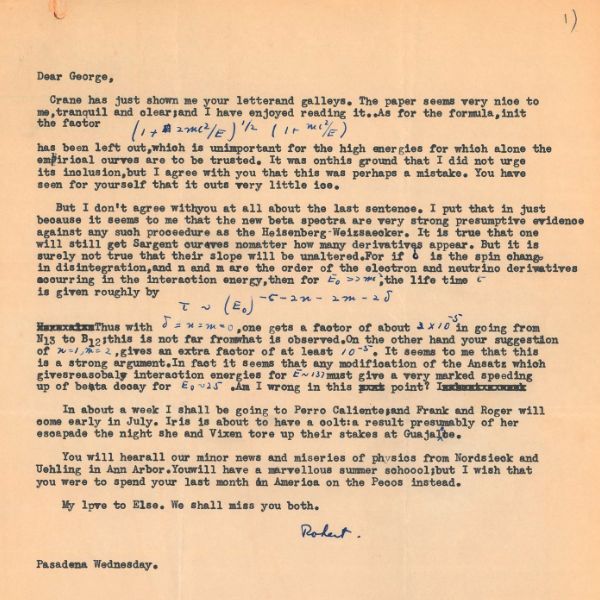
A letter that is suspected to be from J. Robert Oppenheimer, from the George Uhlenbeck collection.
A U-M anthropology graduate, Di Mantova deepened his background in science and technology over his career working with industry and startups. This gave him a framework to understand physics as he researched Oppenheimer and other scientists in archives across the country, and their possible relationship to Armstrong. In the process, he became familiar with the turns of phrase the scientists used in their letters, how they signed their names, what topics they gravitated toward, and more.
That’s how he came to suspect there might be letters in the Bentley’s Uhlenbeck collection that were from Oppenheimer—but not labeled as such because they were undated and rarely signed with a full name.
It’s not too hard to imagine why the letters haven’t been identified as Oppenheimer’s: like today’s emails and text messages, correspondence between close friends of that era didn’t always include the sender’s and recipient’s physical addresses, and envelopes rarely got saved.
But Di Mantova saw plenty of clues.
Sitting at a table in the Bentley’s reading room, Di Mantova pored through folders in Ulhenbeck’s collection one by one, reading letter after letter, for hours on end.
He discovered detailed discussions of beta decay and positron theory, often with Oppenheimer’s characteristic takedowns of other physicists’ papers. “I am now utterly sick of the ramifications of positron theory,” reads one undated letter. “It turns out that the whole second part of Heisenberg’s paper is a swindle.”
Oppenheimer’s fondness for the American Southwest came through as he wished Uhlenbeck would spend time with him in Pecos, New Mexico, instead of Ann Arbor.
Di Mantova says that even the typos are clues. “Oppenheimer was a lousy typist, which you can see in early letters. That goes away when he gets a secretary who knew her way around the keys,” he says.
And then there are the complex, handwritten physics equations scribbled onto paper in his signature style.
Many letters are simply signed “Robert,” which isn’t as conclusive as if he’d signed with his full name or his nickname, Oppie. But Di Mantova notes that even this is somewhat expected. “As his professional stature grew, Oppenheimer’s wife Kitty eventually convinced him to stop signing as ‘Oppie.’”
Continuing the Search
The Bentley is currently in discussions with Di Mantova about how to fully authenticate the letters—of which there are three. But that’s just in the Uhlenbeck collection. There may be more in the papers of other U-M professors who participated in the Summer Symposia. “I don’t know how many Oppie letters there are,” says Di Mantova.
If the three letters currently in question can be authenticated, the Bentley will move them to the labeled folder that already includes documented correspondence between Oppenheimer and Uhlenbeck. Depending on their content, the Bentley may also update its finding aid to better help future researchers.
Meanwhile, Di Mantova’s work will continue researching Armstrong, graphite, and his possible connection to leading physicists. “It’s so exciting to uncover the different relationships through this correspondence,” Di Mantova says. “It’s a critical time for world history, and it’s amazing to see what’s there.”
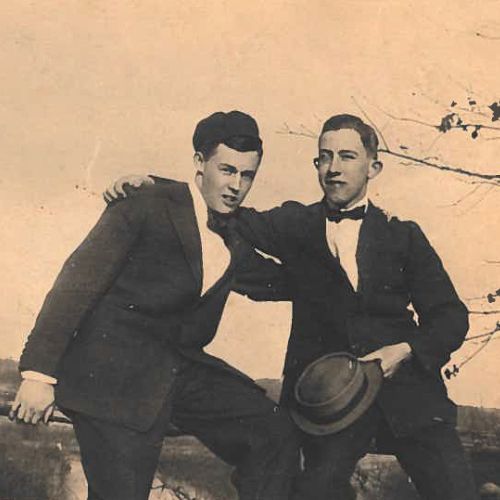
[Photo at top features George Armstrong with a friend as a U-M student in 1908, courtesy of Polly Paulson.]