
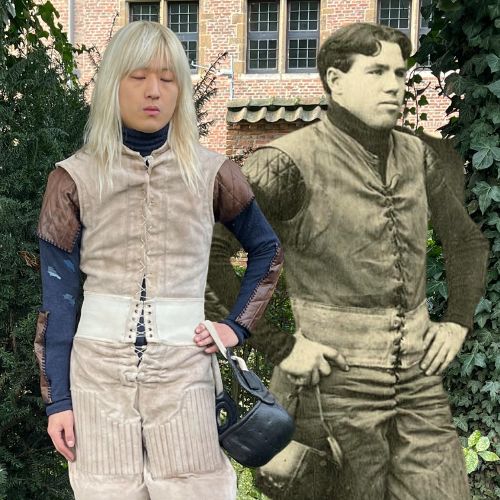
What undergarments did University of Michigan football player Willie Heston wear beneath his 1904 Wolverines uniform?
That’s one of the questions Adam Denzler, a student of fashion at the Royal Academy of Fine Arts in Antwerp, Belgium, needed answered.
Denzler received a school assignment in his second year of studies to recreate a full historical costume from a pre-WWI painting or photograph, including accessories, and yes, even undergarments. “The underlayers are an important part to study,” he says.
In selecting a costume, looking into Wolverines history was a natural step for Denzler. Both his parents and extended family are U-M alums. “It felt like a special opportunity to research something close to home.”
But the undergarments were a challenge. “I couldn’t find any sources specifically describing what American football players in this era were wearing underneath the uniforms,” Denzler says. “Union suits were popular for a small period of time, but mostly in baseball.”
To track down details crucial to his project, Denzler turned to the Bentley.
Bentley archivists located an order form sent by the 1904 U-M athletic director for undergarments, as well as the Spalding clothing catalogs the order referenced.
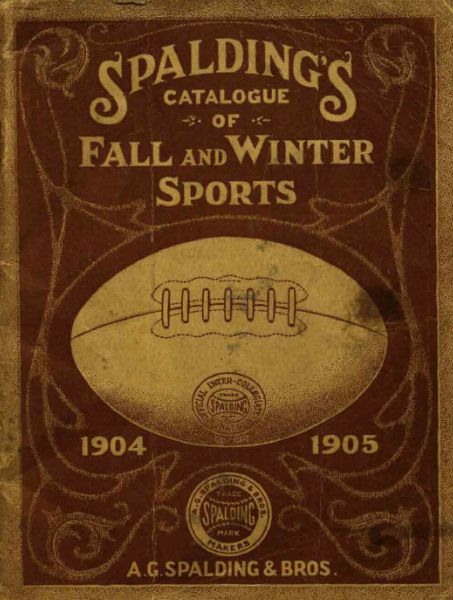
Spalding’s Catalogue of Fall and Winter Sports 1904-1905.
“The catalogs were my main resource, both for the materials and as the only reference pictures,” Denzler says. He then patterned and created the garments by hand.
Beyond getting the undergarments right, Denzler also wanted to capture the fit of Heston’s uniform, as portrayed in an image from the Bentley’s archived Athletic Department records. This meant tireless adjustments to make it “awkwardly laced, wrinkled, and too tight,” Denzler says.
Denzler employed creative processes to give the uniform’s textiles an accurate look and feel including waxing, sanding, coffee dying, painting, creating hand-made stamps, and applying, “in some places, real dirt.”
Leather pads on the shoulders and elbows were sourced from a vintage pair of pants, layered with sanding and shoeshine, while the leather helmet was mimicked using layers of rubber and acrylic paint over a felted shape.
Denzler made sure the textiles reflected wear-and-tear since turn-of-the-century uniforms offered little protection.
According to Bentley athletic records, the leather head caps were quite soft, and sturdier stitched cowhide helmets wouldn’t come into play until the 1920s.
There had been actual resistance to protective gear, which surprised Denzler.
“Across college football in this period, serious injuries were common and the evolution of protective equipment was very slow,” he says.
Thanks to the Bentley, Denzler completed the 1904 football uniform in stunning detail, sewing it himself and modeling the finished ensemble. The process took about three months.
“I’ve always been interested in using archives for creative inspiration,” Denzler says. Primary sources like those at the Bentley show “the ways [that] clothing’s cultural value and signifiers have changed over time.
“The Bentley library was really the most professional and cohesive platform for research in American football uniform history I could find anywhere.”
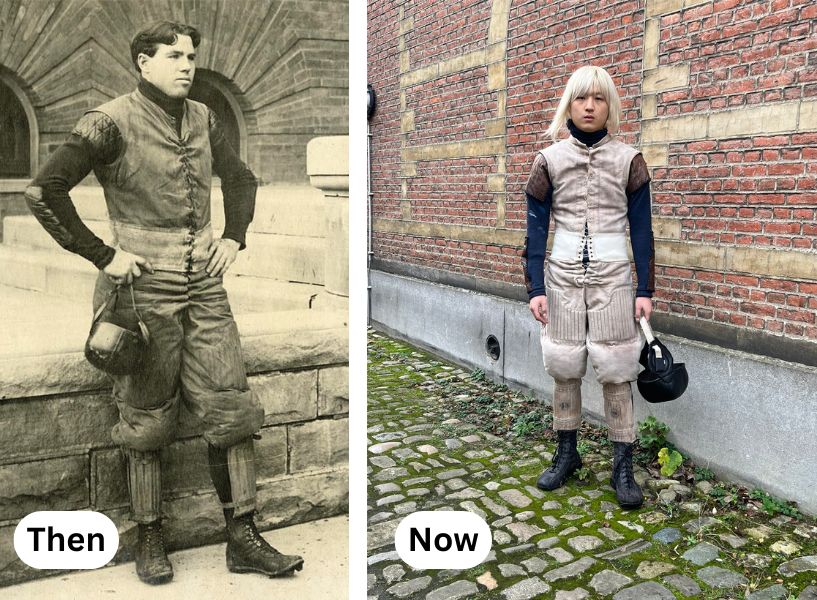
Willie Heston (left) wearing his U-M uniform; Adam Denzler (right) wearing his uniform re-creation.