
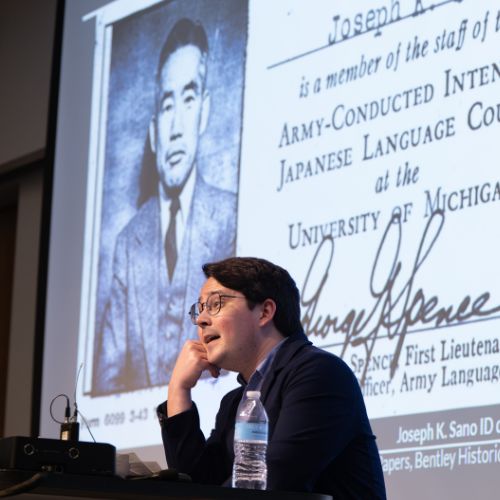
The thin, brown survey copies are tightly packed into a white folder in a box simply labeled “University Housing Records, Box 6.” At first glance, the surveys seem innocuous, asking for information like name, place of birth, relatives, past jobs, and references.
But across the top of each survey is the label “personnel security questionnaire,” which hints at a darker purpose: these surveys were given to Japanese Americans who were incarcerated in camps after Pearl Harbor was bombed in 1941 and the United States entered World War II. Japanese Americans who were deemed “loyal” to the United States could be released to work in jobs across the country, including at the University of Michigan. The Army, keen to guard against potential espionage, told U-M to have Japanese employees fill out the surveys.
Now, the names of incarcerated Japanese Americans who came to U-M to work during WWII are part of a database developed by Bradley Hammond, a Ph.D. student at the University of Southern California and former coordinator at U-M’s Center for Japanese Studies.
Hammond sifted through archived records at the Bentley to uncover the names of the incarcerated, from which he created a searchable database called the Yuzuru J. Takeshita Nikkei Workers Memorial Project. Funded by the Center for Japanese Studies, this project officially documents the names of 401 formerly incarcerated Japanese Americans who worked for the University of Michigan between 1943 and 1945.
“Putting names out there will hopefully spark conversations that help us better understand the full range of the experience for workers,” Hammond says. “There’s also an opportunity to have more conversations about the relationship between universities and internment.”
War Comes to Campus
By 1942, U-M students and staff were leaving in droves to serve the war efforts. But campus was booming: officers and soldiers filled dorms and used U-M as a training ground. The numbers on campus swelled, but there weren’t enough people to wash floors, serve lunches, work in the hospital, and generally keep the place running.
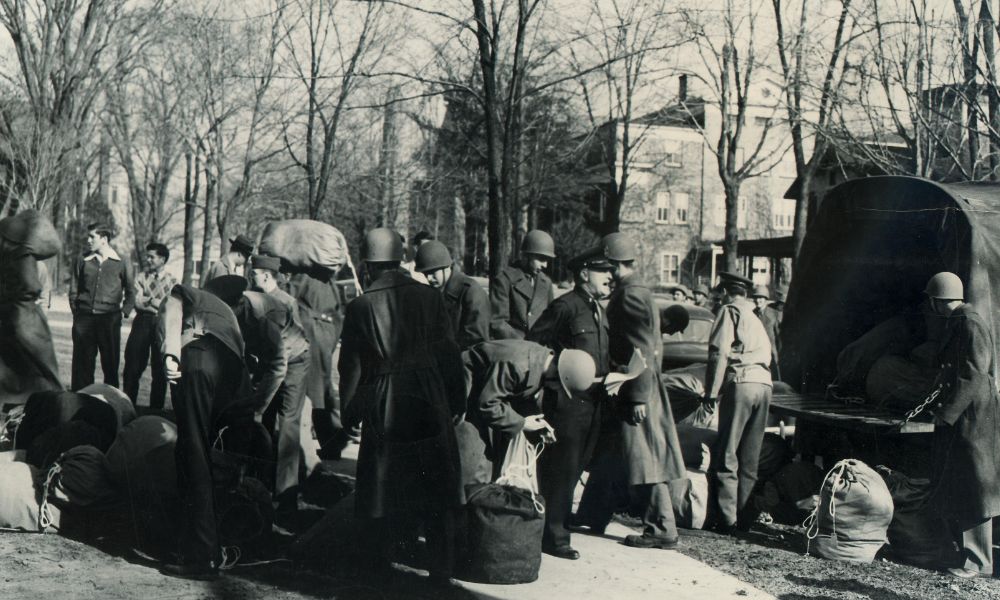
An army unit on campus circa 1941, from the U-M Photo Vertical File.
So U-M turned its attention to the incarcerated Japanese Americans in wartime camps as a labor source.
The boxes full of administrative paperwork documenting the details of the period are both excessively bureaucratic and also a treasure trove of information. “History can often be found in the minutia,” Hammond says.
He painstakingly reviewed these materials and pulled out five categories of essential information for each person: full name, wartime camp they came from, Ann Arbor residence, Ann Arbor workplace, and campus job.
The History of Resettlement
The five categories are a “goldmine of information” says Hammond, especially for genealogical research.
“People will suspect that their grandpa or great aunt was at U-M during the war, and now they can check the database to see for sure.”
Hammond says he’s talked to families who didn’t understand why their relatives came to U-M during this lesser- known period of Japanese American history known as “resettlement.”
“By 1942, the incarceration of Japanese Americans was largely done, people were in the camps, but it wasn’t going well,” says Hammond. “While there were people who were just trying to get by in the camps, there were also strikes and riots breaking out. Those who the administration deemed really problematic were sent to a maximum security facility in northern California; but those who the administration deems ‘loyal’ were given the chance to leave to work.”
Hammond says the archived surveys reveal how young some of the workers were. “Many were still in their teens, and this was probably their first time away from their family.”
Some older, college-educated workers went to college campuses or military installations to teach language classes. Most workers, though, were laborers who went to farms, factories, or seafood processing facilities on the East Coast.
Hammond says U-M is the only place he’s found that had Japanese Americans in both service labor and language programs.
Institutional Responsibility
The University of Michigan opened its doors to Japanese Americans to work but would not admit them as students.
“Admitting students of Japanese ancestry, campus leaders said, was neither ‘wise’ nor ‘desirable’ during wartime because they might be traitors, or worse,” wrote Kim Clarke in her story, These Young Americans (heritage.umich.edu, 2022). Clarke’s story first inspired Hammond to begin locating specific names for the database.
“I can’t shout out [Clarke] enough,” Hammond says. “She shepherded me through the process of digging into the archived records.”
And there’s still so much more to be mined. Hammond says the archived questionnaires list names of relatives and where they lived, plus references. “There’s so much more data here,” Hammond says.
These materials also continue to raise deeper questions. “In reading the archived correspondence, I keep wondering, what is the University’s role in a time of mass incarceration? If you have a labor shortage and you have access to a source of labor that’s not there out of their own free will, what’s an institution’s moral responsibility?”
Hammond unveiled the database in February 2026 at a Center for Japanese Studies event called “Remembering the University of Michigan’s Wartime Japanese American Workers.”
At the event, Hammond specifically talked about Yuzuru J. Takeshita, for whom the database is named. Yuzuru Takeshita died in 2016, but his wife, Joung Sun Takeshita, was able to attend Hammond’s talk.
Yuzuru Takeshita was incarcerated during WWII and became a professor at U-M’s School of Public Health after the war. “When he talked about his internment experience, it’s not about how difficult it was, but rather it was about the importance of people taking moral responsibility in dark times,” Hammond says.
“Talking about histories like this helps us orient our moral compasses.”
Search the new database: myumi.ch/xw1zj