
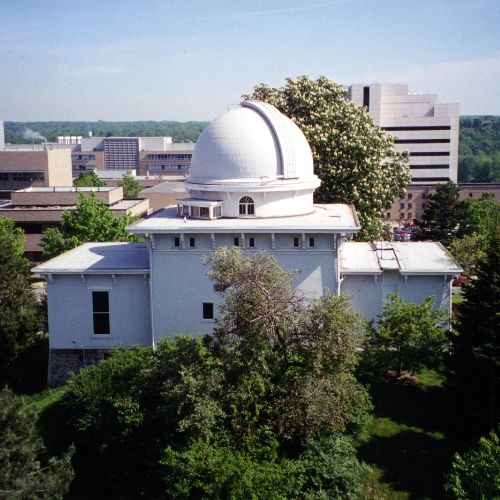
When Margaret and Nicholas Steneck first visited the Judy and Stanley Frankel Detroit Observatory (then just the Detroit Observatory) in 1974, the floor of the dome room was piled with mattresses and Kentucky Fried Chicken wrappers. Someone had painted a desert-themed mural on the dome’s circular walls.
“It was a hangout place for the hippies,” said Nick.
The Stenecks were being recruited by a town-gown group of advocates to help save it.
“The very first question was: You’re a historian of science, you must know why this building is important?” said Nick.
“We didn’t know,” said Margaret, who goes by Peg. “We had to learn.”
The Observatory occupied a small but valuable spot of land on U-M’s campus between two residence halls and across the street from the ever-expanding Medical Center. The Astronomy Department had moved out in 1963, and the building’s 1908 addition would soon be demolished. The original 1854 structure housed two antique instruments of little value to contemporary astronomical research.
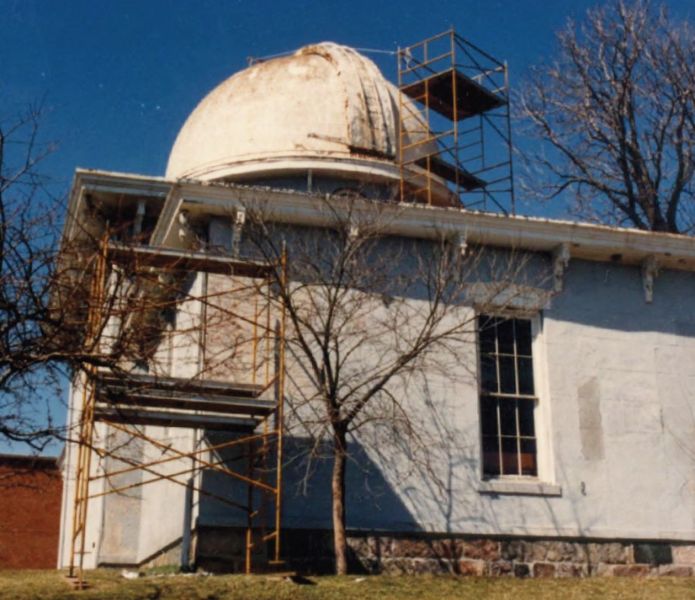
The Detroit Observatory as it looked in the mid-1980s.
Rumors circulated that U-M had rekindled its 1963 plan to level the entire structure, prompting outcry from University and community advocates. Among the many supporters who had been working to preserve the building and rehabilitate it for public use were astronomy professors Hazel “Doc” Losh, Orren Mohler, and Al Hiltner; local preservationists Mary and John Hathaway; and Margo MacInnes from the College of LSA’s Office of Development.
They had successfully petitioned to have the Observatory’s original building added to the National Register of Historic Places in 1973.
“That decrepit-looking globular building on the Hill has finally gotten itself into the history books,” reported The Michigan Daily after the designation was bestowed by the Department of the Interior.
To the few who were familiar with the Observatory’s incredible history, the idea that it was “finally” in the history books was almost laughable. Aside from its record of astronomical discoveries and its legacy in training generations of astronomers, it established the University of Michigan as a bona fide research institution, a move that helped shape the course of American higher education. But this history was not widely known or appreciated at the time. It was new even for the Stenecks, who were both professional historians.
“We realized this building had to be saved,” recalled Peg. “There wasn’t any question in our mind.”
Jersey Roots
Nick and Peg grew up in northern New Jersey and met in high school.
“We ran against each other for student council president,” said Nick. “We both lost.”
“Our friends kind of battled it out. And the third guy walked off with the win,” added Peg.
They went to college near their hometown: Rutgers University for Nick, and Rutgers’ women’s school, Douglass College, for Peg.
They graduated in 1962 and married in 1963, taught high school for a year, and spent a year traveling in Europe, which reinforced the importance of preserving the past. Then they started Ph.D. programs at the University of Wisconsin-Madison. Nick focused on medieval history and the history of science. Peg studied the history of Tudor and Stuart England.
Nick joined U-M in 1970 as a professor in the Department of History, and Peg joined shortly after as a lecturer in the Residential College.
But Nick and Peg weren’t satisfied with just researching, writing, and teaching history. They wanted to save it.
Adaptive Reuse
“The first thing you do is survey your building—find out what you’ve got, what you need to do,” said Peg.
For the Observatory, the list was long. While the 1854 Pistor & Martins meridian circle telescope and 1857 Fitz refractor telescope were mostly intact, the floors were in rough shape, the walls needed paint, and the exterior needed immediate stucco, roof, and foundation work to prevent further decay.
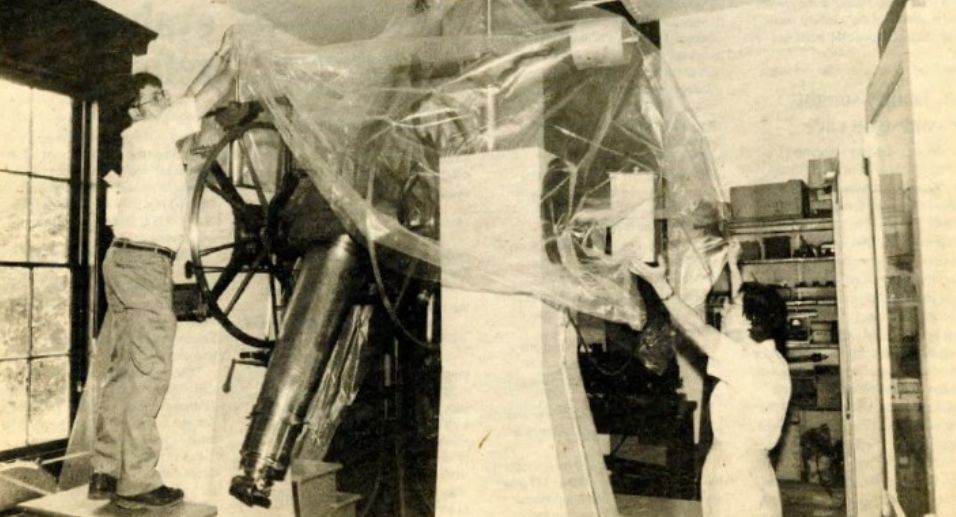
Photo of the Stenecks at the Detroit Observatory in 1989 uncovering a telescope from the University Record.
In 1976, Peg wrote a successful grant application for $10,000 to complete a full site survey and begin exterior renovations. As she noted in a 1991 LSA Magazine article, the process started “with fixing the latch on the trapdoor in the ceiling that let in the squatters.”
This was progress, but the Observatory still lacked a permanent tenant. According to Peg, unoccupied buildings invite unwanted guests, and it’s easier to preserve a place that has utility aside from its historical status. Preservationists call this adaptive reuse. For the Observatory, the most obvious use would have been a museum. But that would have required a large investment from the University, which had other priorities in the 1970s and ’80s.
In the meantime, Nick, along with Al Hiltner, chair of the Astronomy Department, began holding classes at the Observatory. But a more permanent solution was on the horizon.
In 1982, Nick was tapped to lead the University’s Collegiate Institute for Values and Science (CIVS), a think-tank dedicated to exploring research ethics for controversial issues like classified government programs, recombinant DNA, and nuclear science.
CIVS was about to lose its home in the East Engineering building on Central Campus, and Nick proposed relocating the headquarters to the Observatory. It would require additional renovations, but the University agreed.
CIVS moved into the Observatory in 1985. By then, all the interior rooms had been repainted, except for one.
“But there are no plans to clean up the meridian circle room,” wrote Nick to President Harold Shapiro in a letter preserved in Nick’s collection at the Bentley. “I have, as Scout Master of a local troop, a Scout who is willing and able to take it on. The question remains, will the University let him?”
In 1986, Pioneer High School sophomore Ray Comiskey earned the rank of Eagle Scout for leading a team of students who spent more than 200 hours cleaning and painting the Observatory’s last unrenovated space.
Do Not Sell, Alter, or Destroy
The Observatory was a gateway to a broader mission for the Stenecks, who began working diligently to save U-M’s physical history all across campus.
“We discovered through [the Observatory project] that the U-M without a doubt is one of the most important state universities in the United States,” Nick said in a 1989 University Record article.
“To see pieces of greatness slowly being chucked out was more than we could bear.”
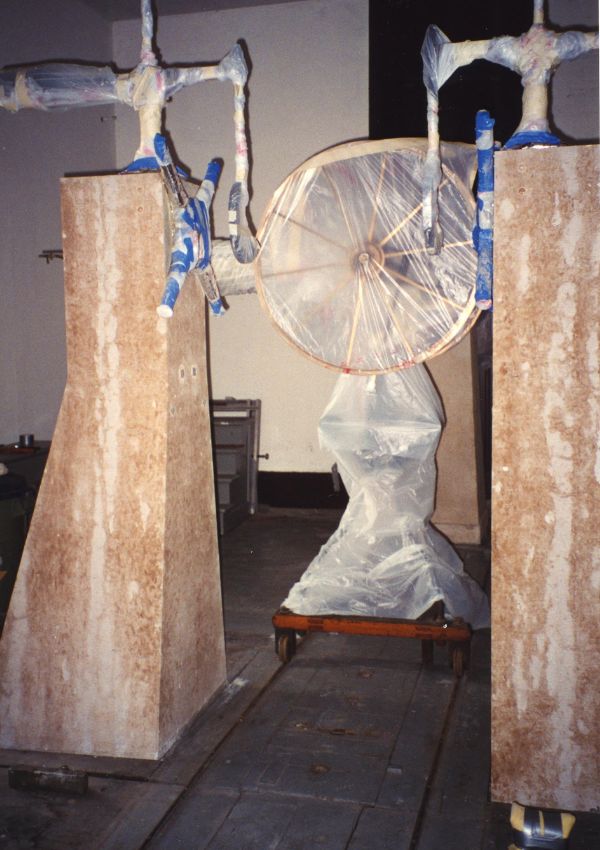
The covered Meridian Circle Telescope at the Detroit Observatory, April 14, 1996.
Items like early iron lungs, one of the first EKGs, and telegraph relays were scattered throughout campus among less valuable items. These pieces of important physical history from U-M were unaccounted for or, worse, slated for the dump. In 1984, under the auspices of CIVS, Nick convened a committee, which included Peg, to prevent these items from being discarded.
They turned to crowdsourcing, sending letters to deans, directors, and chairs asking for their unit’s help in identifying significant and at-risk artifacts.
Nick’s papers at the Bentley include a few of the responses, which run the gamut from “a fairly extensive collection of Civil War surgical instruments and kits” to a nuclear reactor used for “research in peaceful uses of nuclear energy.”
A “Historic Scientific Instrument” tag was tied to each, alerting future handlers not to “alter, sell, or destroy” the artifact.
There were teeth behind the tag’s warning. Nick lobbied to amend the policy on property disposal, leading to a revision to the Standard Practice Guide, U-M’s core procedures manual. The amendment added “historic significance” to the criteria used to evaluate property for disposition (this was removed in 1998).
In some cases, time was of the essence. Before the University Hospital—“Old Main”—was closed in 1986, Nick trolled for leads before dispatching students from a first-year seminar course to scour the corridors and tag potential items.
The most at-risk instruments were moved to the Observatory’s meridian room for short-term storage, and the eventual plan was to display them publicly. But the initial focus was preservation.
When the Historic Scientific Instrument Survey published its results in 1988, it had tagged and cataloged hundreds of items.
No Historical Cheerleading
The same drive that pushed the Stenecks to save the University’s history compelled them to share that history with others. In 1986, Robert Forman, director of the Alumni Association, approached Peg with the idea of an alumni mini-course on the history of the University.
Peg and Nick collaborated on the course’s development and co-taught it for the first time in fall 1987 with an enrollment of 70 students. Some faculty were dubious of the intellectual rigor of the endeavor, and national media joined the chorus of skepticism. Rolling Stone included the course on a national list of ultimate blow-off courses, “classes so easy your dog could pass.”
But the Stenecks were deadly serious about the topic’s academic merit, and their students knew better than to take the topics lightly—at least according to their evaluations. “This was not just a cheerleading seminar!’” read one.
Another reported: “Anytime I told someone that I was taking history, they’d ask which one. I’d answer, ‘the history of U-M.’ The general reply was, ‘you get credit for taking that?’ Well, I worked hard for the credit.”
Nick and Peg worked hard, too, developing the syllabus and taking more than 500 photographs of items archived in Bentley collections for slides to augment their lectures. The course became a staple for the History Department, and in later iterations they invited University presidents past and present to guest lecture. Every president from Harlan Hatcher to Lee Bollinger accepted.
“It is clear that if taught properly, a university history course can be an experience that allows students to learn and understand historical events of far broader significance than recounting the outstanding moments of the university’s history,” they noted in their 10-page report on the course’s initial offering, which can be found at the Bentley.
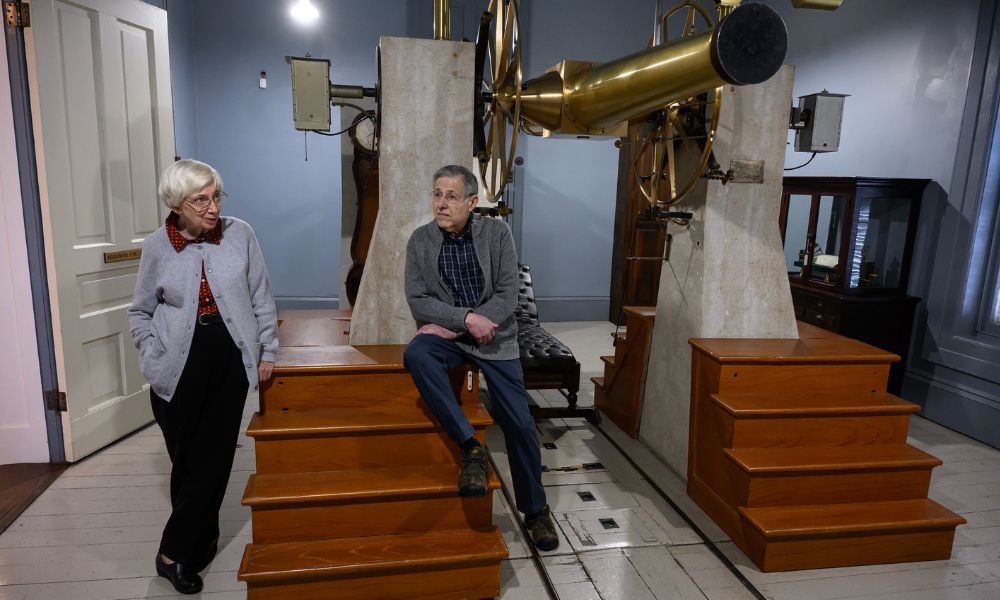
The Stenecks visiting the Detroit Observatory in the modern day.
University History Reimagined
The Stenecks weren’t the only ones involved in historical preservation on campus, but they were often the conveners. In a bureaucracy as large as the University’s, just knowing whom to talk with is a valuable skill. And in an era of fiscal precarity, they framed improvements to the Observatory as both historically necessary and economically viable.
By 1974, when the Stenecks joined the Observatory’s cause, it’s unclear if the University would have actually torn down the 1854 building. But their work during the next 20 years stabilized the structure, showcased its potential, and helped inspire new allies, including President James Duderstadt, Anne Duderstadt, and Vice President for Research Homer Neal. This teed up its full renovation in the late 1990s under the leadership of Director Patricia Whitesell.
Beyond bricks and mortar, the Stenecks positioned the Observatory as part of a broader effort to examine the University’s past. The Historic Scientific Instrument Survey, the history of U-M course, and their work on other projects—acquiring the diary of 1845 graduate George W. Pray; leading the Historical Center for the Health Sciences; revising The Making of the University of Michigan; and more—all helped reimagine how the University might study its own history through a critical lens.
In 2022 the Observatory gained a state-of-the-art addition that realized what the Stenecks envisioned in the 1980s: a public venue for showcasing the history of the University of Michigan. It was renamed the Judy and Stanley Frankel Detroit Observatory in honor of the donors who made the addition possible.
When the Stenecks visited the Observatory to sit for an interview for this article, there was very little actual sitting involved. They spent most of the time in the historic building, thinking back on their time at the University and reflecting on their own history.
Nick and Peg retired from U-M in 2006, but they weren’t finished with historic preservation. Based in Ann Arbor, they are active in preserving a national historic site and adding to museum collections in their home state of New Jersey.
“Maybe someday we will actually retire, but not just yet,” said Peg.