
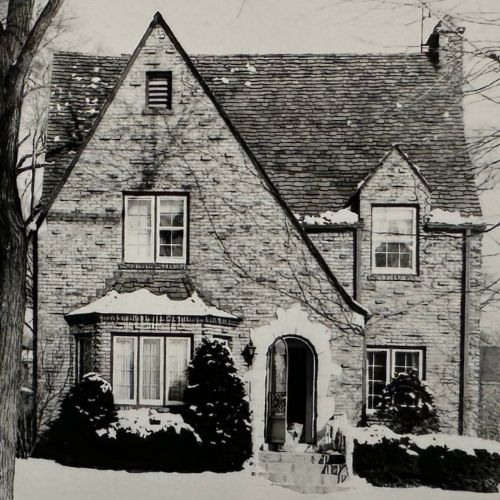
“Well, you’re a woman, and the law says we have to take you; but I’ll tell you right now we don’t want you.”
Professor Emil Lorch’s discouraging words, remembered years later in a 1981 Ann Arbor News article, only made Bertha Yerex Whitman more determined to enroll at U-M as an architecture student.
In 1914, she did just that.
At the time, Lorch led U-M’s Department of Architecture, which had just separated from the Department of Engineering. He would later become the College of Architecture’s first dean.
Whitman already had a teaching certificate from Eastern Michigan University, but after three years working as a teacher in Newaygo, Michigan, she was ready to try something new. She set her heart on an architectural career, hoping to combine her talents in math and drawing.
Her mother agreed to support her return to school, provided Whitman agreed to do “all the washing and scrubbing” at her mother’s 21-room boarding house, according to the Michigan Alumnus magazine.
Whitman accepted readily. She was no stranger to hard work. Supporting her family had been at the core of Whitman’s life ever since she was young.
“My father died when I was 10 years old, and I had to take over the man’s work around the house,” Whitman wrote in My Grandfather and Me, an autobiographical booklet that survives at the Bentley. When she wasn’t splitting firewood or doing housework, her childhood was spent working on the farm for her grandfather, a hard-working man she affectionately described as a “pioneer,” whose determination inspired her all her life.
An architectural pioneer in her own right, Whitman arrived on campus just as World War I was breaking out in Europe. Reminders of the distant war appeared regularly in The Michigan Daily, hinting at the conflict to come.
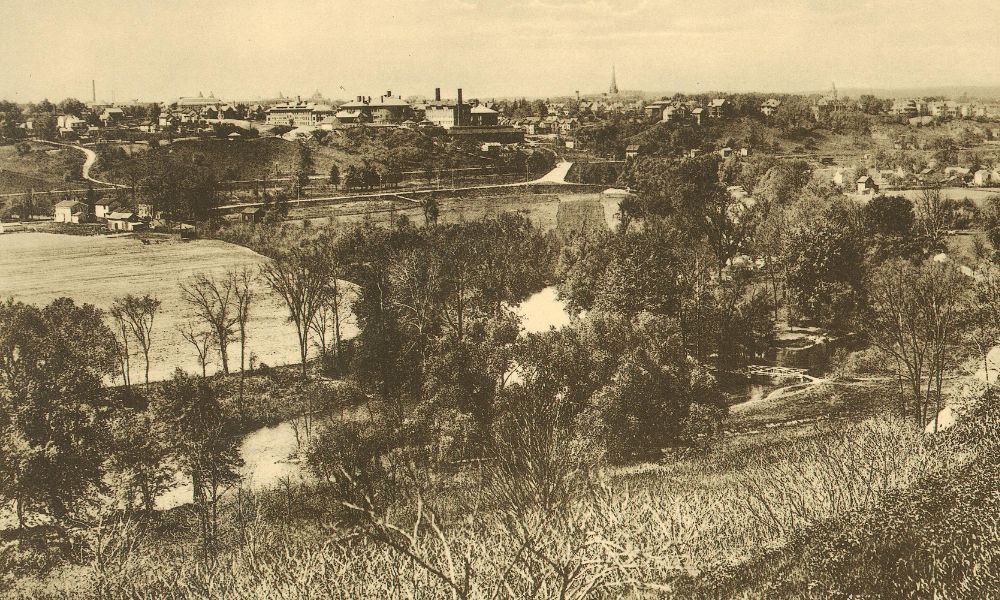
A view of Ann Arbor from the Boulevard circa 1914, around the time that Bertha Whitman arrived, from the U-M Photograph Vertical File.
The T-Square Society
Whitman soon discovered that she faced restrictions that her male classmates didn’t. She was forbidden to attend class field trips to study architecture.
“It wasn’t considered a suitable activity for a woman,” she told the Michigan Alumnus in 1977. Men also had professional clubs on campus where they could socialize and build networks for their future careers. No such clubs existed for women studying architecture.
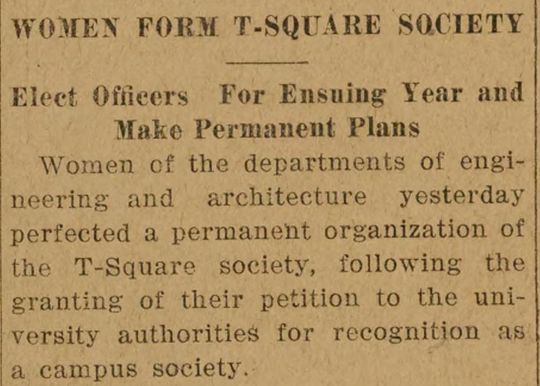
Article from the December 9, 1914 Michigan Daily about forming the T-Square Society.
Whitman was determined to fix that. She banded together with a handful of like-minded women to form the T-Square Society, creating an organization for mutual support, friendship, and education for women studying engineering and architecture at U-M. Whitman was elected as president of the society in 1915.
Over time, Whitman also befriended her male classmates as they worked together in the design studio. When many left to join the war in 1917, she took a hiatus from school so that they could all graduate together upon her classmates’ return from the battlefield. She moved to Detroit and became the first woman draftsperson for the engineering division of the Dodge Brothers Motor Car Company, better known today as the Dodge car company.
After the war, Whitman returned to U-M to complete her degree with her classmates, becoming the first woman known to earn her bachelor of science degree in architecture from U-M’s Department of Architecture in 1920.
Her graduation helped open the door for women studying architecture, but her own uphill battle to become a professional in the field had just begun.
The Most Intense Education Conceivable
Dean Lorch advised Whitman to move to Chicago after graduation, a city with so many architects that one of them might be willing to hire a woman, according to Whitman’s own account in her archived papers.
Lorch was skeptical of her chances.
Still, Whitman was determined to try. She married Lloyd E. Whitman, a man from her hometown who worked in the auto industry, and went to stay with her aunt in Chicago. Then she began knocking on doors, arranging interviews, and reaching out to the architects living in the city.
Door after door closed in her face.
“After a couple of weeks searching daily for employment, I felt that I might never get a job as an architect,” she later wrote in an account of her career, preserved in her papers at the Bentley.
Of the many architects she contacted, she wrote: “Some flatly refused to see me.”
Others hedged. They would be happy to hire her, they claimed, if only they had job openings, but they didn’t. Whitman didn’t give up. She widened her search. At last, she reached out to Perkins, Fellows & Hamilton, an architectural firm on Michigan Avenue. It was a good choice. One of the firm’s partners, Dwight Perkins, knew firsthand that women could be architects: his cousin Marion Mahoney Griffin was among the first licensed women architects in the United States.
Whitman was welcomed to the firm as an architectural draftsperson.
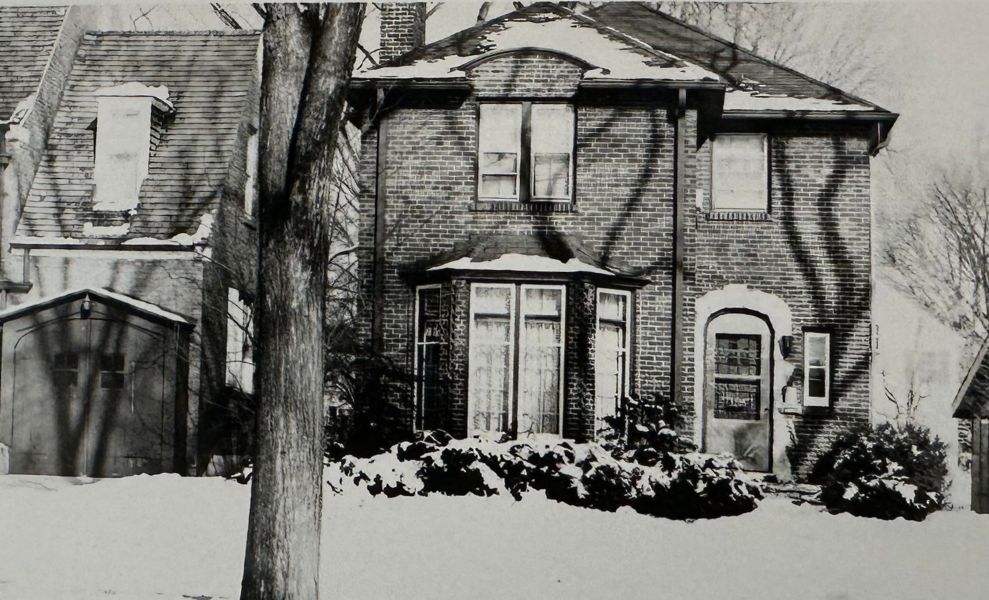
House designed by Bertha Whitman, 3205 Hartzell, Evanston, Illinois.
Her desk was in the back corner of the drafting room, separate from the men. Despite that clear divide, Whitman was interested in every aspect of the work around her. She learned from any architects willing to teach her, absorbing each detail of how projects were created.
“Everyone was friendly, and we socialized even with the partners,” Whitman later wrote. “I had the most intense education conceivable. I worked with every person.”
Her talents seem to have opened a door: more women began to be hired at the firm over the years, including U-M alums Ruth Perkins and Juliet Peddle.
Whitman also carried forward her devotion to creating spaces where women could support each other by helping found the Women’s Architectural Club of Chicago. She would later become the club’s president.
Peddle, one of the club’s cofounders and Whitman’s own coworker, would prove crucial to Whitman’s career.
Rising to the Challenge
Whitman left her work as a draftsperson at Perkins, Fellows & Hamilton in 1923 while expecting her first child. For many women, having a child meant being expected to end their careers.
But Whitman still dreamed of being an architect.
Peddle offered a new path forward. Peddle wanted to earn her license to practice as a solo architect and encouraged Whitman to take the 1926 licensing exam alongside her.
Whitman rose to the challenge.
“The Board decided to hold the examinations in Chicago that year,” she wrote. “I was pregnant with my second child, a son. My mother came to care for our three-year-old. I reviewed my work. I took review courses in engineering at Chicago Technical College.”
In the afternoons, she studied relentlessly. Although she no longer worked there, her former colleagues welcomed her to use the Perkins, Fellows & Hamilton library to prepare for the exam.
She passed, earning her license on her first try.
I Just Went Ahead and Did It
License in hand, Whitman moved to Evanston, Illinois, and began building her solo architectural practice. Word of mouth was crucial, and her connections with contractors, built while working as a draftsperson, helped her spread the word. Requests for home designs began coming her way, along with apartment buildings, schools, and churches.
Whitman loved creating practical, well-engineered spaces that were easy to live in. As someone who had done housework all her life, she believed she had crucial insight into how to use space efficiently.
She described many of her designs as “Colonial-modified” houses, with influence from Georgian, Cape Cod, and Beaux-Arts design styles, but she also loved to take on new types of projects she hadn’t tried before.
“I never considered whether or not I could do a job; I just went ahead and did it,” Whitman told architect Lorri Sipes in an article for U-M’s Architectural Discussions book in 1978.
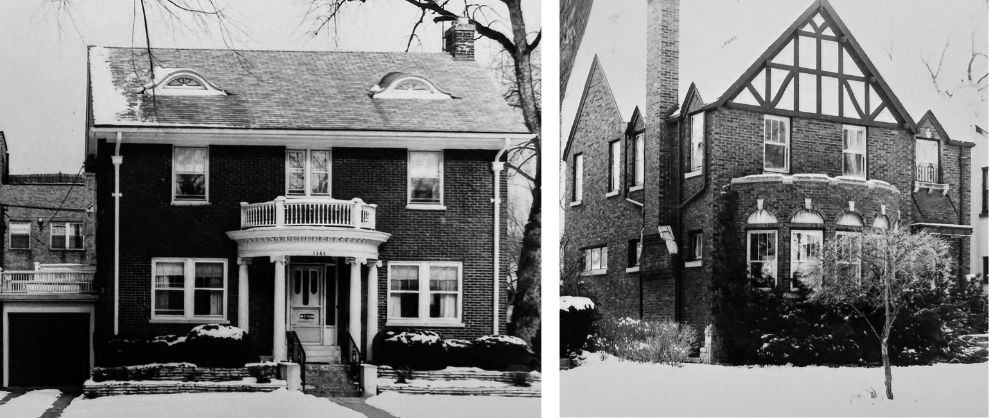
Two homes designed by Bertha Whitman: 1308 Rosalie, and 840 Lincoln, both in Evanston, Illinois.
For many years Whitman was “the only female architect in Evanston,” according to Sipes.
Whitman’s work started to gain recognition in the 1930s. One of her house designs won a “Better Homes” award in 1931, and she was asked to help design the women’s booth for the 1933 Chicago World’s Fair, where that design was featured.
Then the Great Depression hit her life like a thunderbolt.
Her husband lost his job. In response, he simply walked out the door and never came back, abandoning their family during one of the most economically difficult times in U.S. history.
Whitman suddenly found herself raising two children alone.
She shifted from career to career to keep her family afloat, becoming a social worker for the city of Chicago for several years, a job interviewer for the Division of Unemployment Compensation, and even remodeling government buildings, all while working on her architectural practice on the weekends.
We Women Are Just as Good as They Are
As the economy stabilized, Whitman’s life expanded.
She took dance classes and began to travel the world to study architectural styles, writing about her experiences.
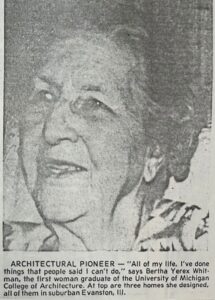
Bertha Whitman newsprint photo from an archived clipping of the Ann Arbor News, 1981.
Her work also evolved, as her friend Kate Ransom later explained in writing preserved in Whitman’s papers: “She simply began to do more of what she wanted to do; more private homes on larger sites which gave her more artistic and architectural freedom.”
By the time her last house was designed in 1974, Whitman had “designed enough buildings to stock a small town,” according to the Michigan Alumnus. That year, her work as an early woman architect was recognized by Eastern Michigan University with an award for “distinguished service to mankind.”
Whitman returned to Ann Arbor, where the Ann Arbor News reported that she spent many of her later years using recycled materials to make art, with the same enthusiasm she’d once used to design buildings. She kept telling her life’s story, believing it was important to share.
“I’m not Shakespeare or Frank Lloyd Wright,” she explained to the Chicago Tribune in 1973. “But I enjoy what I do, and I enjoy showing men that we women are just as good as they are in whatever we do.”
Her legacy lives on in the archives, where visitors can read about Whitman’s life in her collection of papers and see many photographs of buildings she designed.