
The stack of old CDs was piled 102 discs high.
Each one stored more than 300 photos from the women’s softball team from 2001–2008.
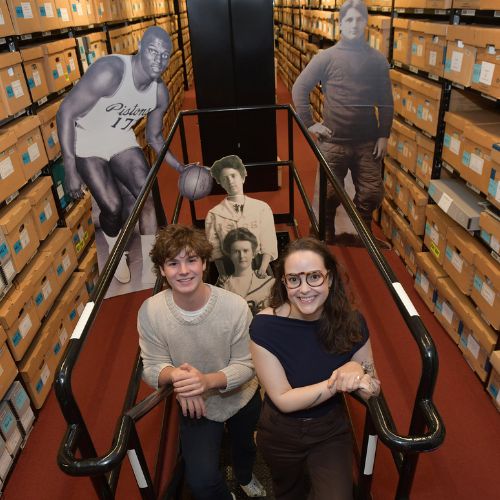
The discs comprised more than 15,000 photos showcasing practices, games, championships, teamwork, and more. The pictures were a critical part of Michigan women’s sports history, and the work of getting the images off the vintage CDs— and making them digitally available to researchers—was entrusted to Lily Fritsch and Nate Schreck, the first cohort of Peikert Fellows at the Bentley Historical Library.
Funded through a generous donation from Michael Peikert (LSA ’70) and Frances Peikert, the fellowship supports one undergraduate and one graduate student researcher at the Bentley for eight weeks during the summer with a focus on preserving U-M athletics history. Fellows learn about the history of U-M sports as well as build professional archival skills.
This year’s graduate fellow, Lily Fritsch, says she was excited that so much of her work was focused on women’s athletics. “I love women’s sports and the structures of competition prior to Title IX,” she says, noting that women’s sports are still “wildly under-archived.”
Originally from Portland, Oregon, Fritsch is working toward her master’s degree in U-M’s School of Information. She previously worked at Bowling Green State University’s Cochrane Cunningham Athletic Archive curating exhibits and cataloging the university’s athletics collections, a job that she says “uncovered her love of sports.”
Undergraduate Nathan Schreck says both his advisor and his mom sent him the posting about the Peikert Fellowship and encouraged him to apply. An American culture and philosophy double major from Rochester Hills, Michigan, Schreck is also a sportswriter at The Michigan Daily. Through his work at the Bentley he says he’s received “a more holistic understanding of the U-M Athletic Department and its history, which is helpful as a writer.”
As a Peikert Fellow, Schreck also researched U-M baseball scorecards. The Bentley has more than 50 scorebooks from various baseball seasons, which Schreck studied to learn more about scoring styles and for insights into U-M baseball history. His article about the scorecards was published in an online Collections magazine story in July 2025.
Fritsch helped process the papers of Carl Grapentine, the longtime announcer for the Michigan Marching Band and “the voice of the Big House.” Her article on the Michigan Marching Band’s newsletter, The Leaky Bugle, will appear in the Spring 2026 issue of Collections magazine.
“Archives are great because there’s always something new,” Fritsch says. “This experience has curated my interest in archives while also expanding it.”
Fritsch and Schreck also processed 105 additional CDs with thousands of images from women’s rowing, women’s field hockey, and women’s cross country from 2000–2009. These images, along with those from the women’s softball CDs, will be transferred to a digital repository and made publicly available.
“I want to help make people aware of the archives—donating to them, exploring them, and making sure people know that they can use them,” Fritsch says.
Schreck agrees: “I’m passionate about the public aspect of this work, and how we’re helping people by making things in the archive more easily available. It has a tangible impact.”