Detroit radios crackled with the voice of antisemitic preacher Gerald L. K. Smith in the 1930s. His papers at the Bentley Historical Library include typed rambles describing imaginary conspiracies, radio transcripts, and letters about his failed attempts to run for political office.
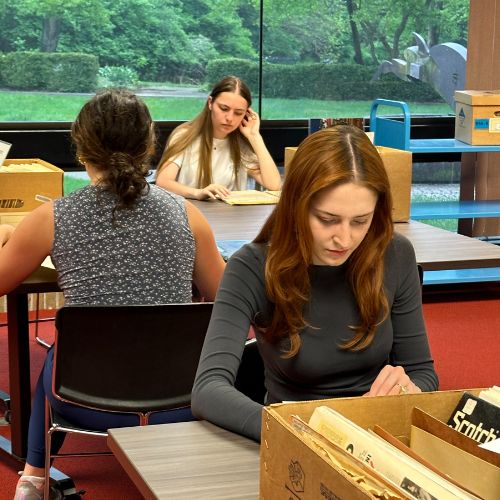
Looking at Smith’s papers, a group of students sitting in the Bentley’s classroom had questions.
How well known was he? Did people actually listen to him?
These students were participating in the History of Hate in the Great Lakes Region project, part of the annual Michigan in the World internship program, which has been putting Michigan’s history into a larger global context for years. This past summer, the project was led by Jeffrey Veidlinger, a professor of history and Judaic studies and director of the Raoul Wallenberg Institute. It also included Miriam Eva Mora, managing director of the Wallenberg Institute, Joseph Ho, manager of the Eisenberg Institute of Historical Studies, and Bentley archivists led by Associate Director for Public Engagement Meghan Courtney.
During this paid internship, students obtained hands-on experience with archives, learned to think critically about difficult history, gained collaborative research skills, and learned to translate historical information so that it’s accessible to anyone.
Students will use their newfound skills to create an online exhibit based on their research, sharing their findings with the public alongside archived letters, photos, and more.
“[The students] are learning how to make critical, persuasive arguments with carefully collected evidence, which is a skill that’s applicable to every field in the world,” said Ho.
At the Bentley, Courtney encouraged students to ask critical questions about the archived materials they were studying such as: Who wrote this historical document, and who did they write it for? What tools are they using to try and convince the reader?
Students discussed how words like “communist” were often applied to people Smith disagreed with, to paint them in a specific negative light.
“We’ve been focusing on knowing how language is manipulated, and why,” said second-year undergraduate student Eden Reavis, who also described parallels between hate movements in the past and the present. “It surprised me how similar their thinking is,” she said.
In this way, the internship helped students deepen their media literacy skills, since rhetoric used by historical hate groups to try to persuade people can still be seen today. Students learned how to better spot it.
“These students are learning to be really savvy about how historical materials interact,” Ho said. “With all of the material generated by AI today, and so much misinformation circulating online, it’s important that students are learning to actively engage with diverse information.”
Despite all his letters and speeches, Smith lost his campaigns for the Senate and the U.S. presidency, revealing another lesson from history: hate movements are not always as effective as they want everyone to think.
“It’s important that hate is something we recognize, so we don’t repeat it,” said third-year undergraduate student Jeanette Lawrence.