
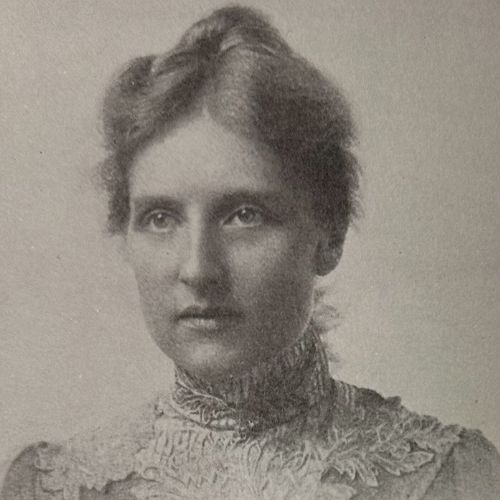
Gertrude Buck watched as Edna St. Vincent Millay, dressed as a princess, argued with a page boy from her seat in a castle tower. Millay was a senior at Vassar College, starring in her own one-act play, The Princess Marries the Page, with a whirlwind plot of subterfuge and medieval politics.
This play was one of several produced by the Vassar Dramatic Workshop since Buck, a University of Michigan alum, founded it in 1916. Millay, who would become a famous poet and a significant contributor to 20th-century literature, was just one of the many students shaped by Buck’s innovative work as a Vassar professor.
A strong believer in civic participation, Buck encouraged the women in her classes to share their opinions through acting, writing, and public speaking. She believed communication was crucial for building community, and that every voice mattered.
The archives reveal how Buck’s own writing and speaking helped reshape the world around her, including breaking barriers for women at U-M, pushing for women’s right to vote, founding Vassar’s drama club, and doing foundational work for the field of feminist rhetoric.
In the process, she frequently blazed a trail for others to follow.
The Adventures of Kitty Carew
Born in Kalamazoo in 1871, just one year after women were first admitted to U-M, Buck had already broken a lot of ground by the time she became a Vassar professor. The daughter of a local judge, she started writing early, and her work was first published at age 14 in the Christian Advocate. She graduated from Kalamazoo High School at the top of her class in 1890 and applied to the University of Michigan that same year.
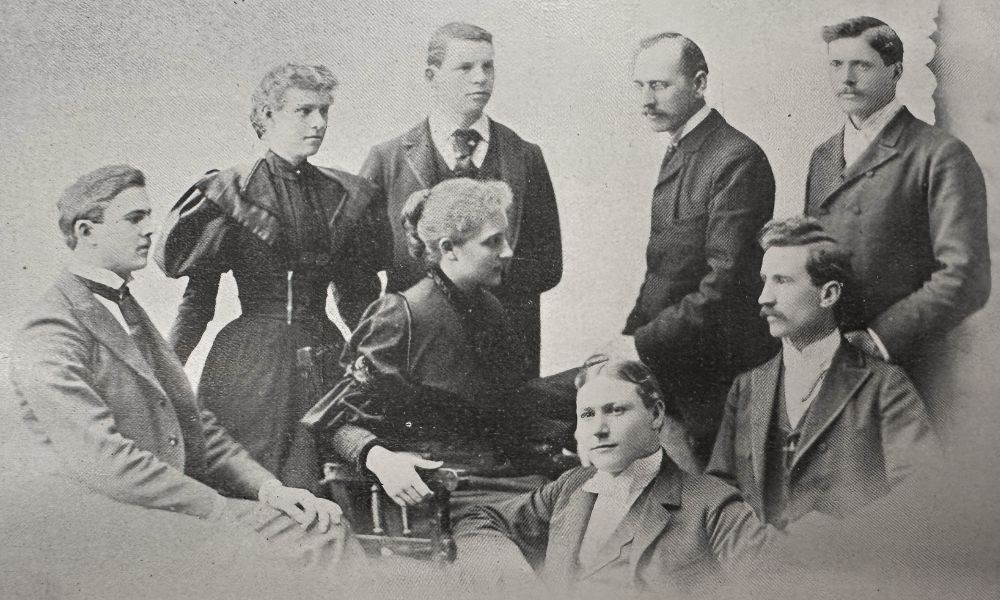
The University of Michigan Oratorical Association in 1894, including Gertrude Buck (seated) as the association’s president.
A prolific writer, Buck was reportedly the first woman invited onto the board of The Michigan Daily newspaper. U-M yearbooks and her alumni file detail her role in a dizzying number of student organizations: she was president of U-M’s Oratorical Association; managing editor of the Student Christian Association’s monthly Bulletin; vice-president of her senior class; and a member of Alpha Phi, the Women’s League, and U-M’s Press, Literary, and Philosophical Clubs.
As her many activities could attest, Buck believed education wasn’t just found in books; it was also found by experiencing the world. In the Bulletin, in an article titled “Your First Year at University,” she advised:
“Don’t consider yourself in any sense educated until you know the meaning of common things about you: the grass, the stones, bees and earthworms, clouds and trees. Don’t raise such a dust poking about Greek antiquities that you cannot see to read the delicate tracery of God’s handwriting on every square inch of this round earth.”
Buck wrote about her own observations in articles, poems, and songs for U-M publications like The Inlander, The Castalian, and The Oracle. She also wrote tongue-in-cheek articles about life as a U-M student for the 1890s Detroit News under the pen name Kitty Carew.
Her articles described bustling life in an Ann Arbor boarding house, canoeing down the Huron River, dancing at the Junior Hop, and visiting the dissection room at the Medical School to see if she might want to be a “medic.”
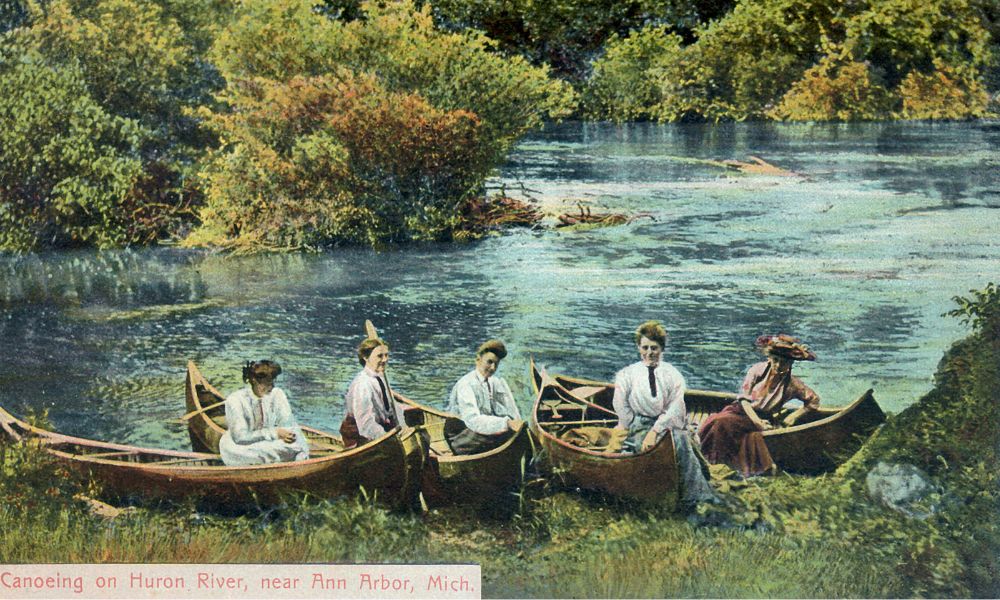
A historical postcard of women canoeing on the Huron River, an activity Gertrude Buck enjoyed at U-M.
“The girls won’t let me tell about how we gave the boys a leap-year sleigh ride to Ypsi, and got back the next morning at 6 o’clock in a benevolent farmer’s hayrick, having left our sleighs in his barn five miles from town on account of a malevolent thaw,” she wrote in the 1892 Detroit News, adding: “The story is all over college, so I might as well, though.”
In another article, she advocated passionately for a women’s gymnasium to be built at U-M, quoting one woman who dared to play ball in the street with friends: “Everybody who went by stared at us with derision or disapproval, and we haven’t heard the last of our performance to this day! But the boys can play ball in the street every day if they want to, and it’s alright.”
Her articles included so many details about university life that people doubted the author could be a woman, despite the Detroit News publishing several articles revealing Buck’s identity. In the 1893 book The Literary Century, the Michigan Women’s Press Association described her as “one of the born journalists of the day, a woman who has the true newspaper instinct.”
Buck tried studying Greek, medicine, and English, before earning a Bachelor of Science degree in 1894, then a Master of Science degree in 1895. She pursued a Ph.D. under the tutelage of U-M Professor Fred Newton Scott, who shaped how language was studied at the time, focusing on the importance of audience and language’s democratizing nature. Buck was fascinated. She had found the field that would shape her life: the study of rhetoric.
Buck’s academic specialty, composition-rhetoric, focused on writing and teaching, as part of a wider entire field dedicated to how and why people communicate with each other. Buck’s 1898 Ph.D. in rhetoric was the first awarded at U-M, and the first Ph.D. in composition-rhetoric awarded to anyone in the United States, according to San Diego rhetoric professor Dr. Suzanne Bordelon.
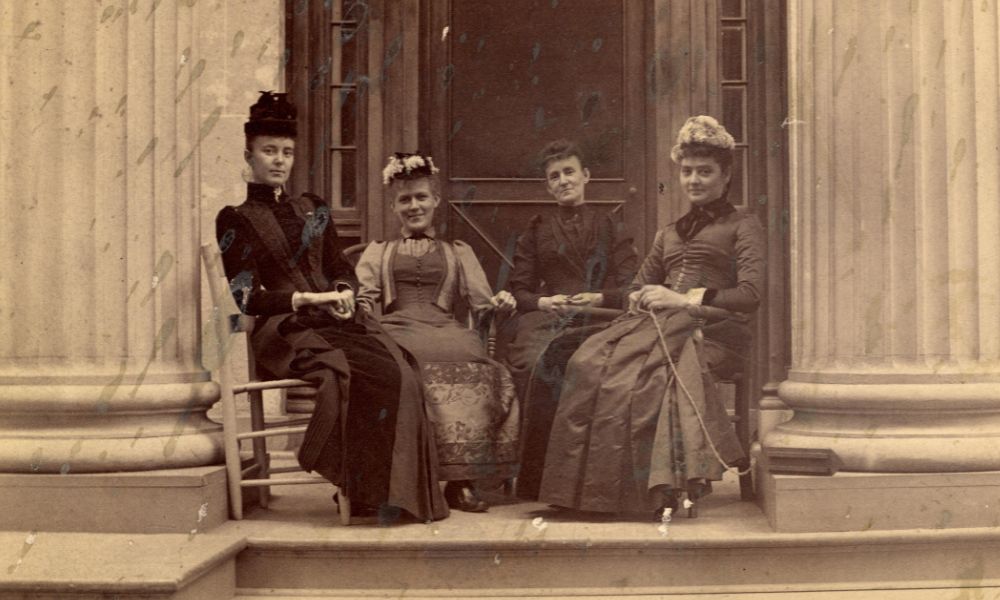
Alpha Phi sorority members, including Gertrude Buck (second from left) at the University of Michigan.
With All of Our Common Experiences
Although Buck herself had participated in speaking competitions at U-M, she didn’t accept the idea that persuasive rhetoric was inherently antagonistic. The book Towards a Feminist Rhetoric: The Writing of Gertrude Buck, by JoAnn Campbell, notes how Buck’s work “challenged a two-thousand-year tradition that defined persuasion as an act of war.”
Instead, Buck considered how psychology influenced people’s words, and how rhetoric is shaped by community. To Buck, language wasn’t “isolated,” but rather “interwoven with all our common experiences.”
“Only as we relate other people’s experiences and ideas to our own are we able to see what we have to contribute,” Buck wrote in the 1920 Vassar Miscellany News.
However, she didn’t always treat those experiences equally, despite her belief in their importance. In Organic Education, a book co-written with Fred Newton Scott’s sister Harriet Scott in 1899, she encouraged students to relate to other cultures but also ranked those cultures according to their perceived “civilization,” using stereotypes at odds with the empathy she hoped to inspire.
While earning her doctorate, Buck worked as a fellow at the University of Chicago, a teacher at the Detroit Normal Training School, an unpaid assistant in English at U-M, and a teacher at Indianapolis High School. Vassar hired her soon afterwards, beginning one of the most impactful portions of her career.
Pioneering Feminist Rhetoric
Buck advanced as a teacher, becoming a full professor at Vassar in 1907, and teaching what was described as “almost every variety of writing.”
“Her way was to teach a new subject, and, as soon as she was convinced of the effectiveness of the method employed, to embody the results in a book, initiate another teacher, and then pass on to a new field,” Vassar Professor Amy Reed noted in a 1922 clipping titled “News Miscellany,” archived at the Bentley Historical Library. Several of the volumes Buck wrote can also be found at the Bentley.
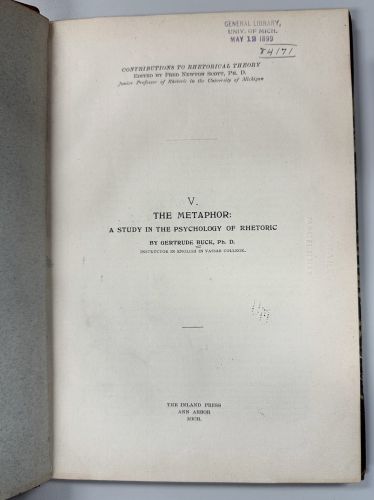
Gertrude Buck’s dissertation, titled “The Metaphor: A Study in the Psychology of Rhetoric.”
Buck encouraged students to consider the real-life applications of rhetoric, including women’s rights. In her books, she provided statements like, “Women should receive the same salaries as men for the same work,” and “Women will be allowed to vote on all questions in all states,” around which students could create arguments.
“Buck’s textbooks and debating activities at the college encouraged Vassar women to think about women’s issues, and her approach to argumentation, with its emphasis on social action, communal interests, free inquiry, and equality, ultimately had feminist effects,” Bordelon writes in her book, A Feminist Legacy: the Rhetoric and Pedagogy of Gertrude Buck.
These “feminist effects” led Buck’s work to be considered by Campbell, Bordelon, and others as foundational for today’s feminist rhetoric.
Buck didn’t work in a vacuum: she was influenced by people like her mentor Fred Newton Scott, who believed rhetoric was a democratic force. She wrote to Scott while working at Vassar, exchanging ideas, and even pushing for women’s representation back at U-M.
“Some of us here feel rather strongly that the Alumni Advisory Board at the U of M ought to include more than one woman,” Buck wrote in a 1910 letter preserved in Scott’s papers. (There were more than 20 members on the Alumni Advisory Board at the time, all but one of whom were men.)
Scott scribbled in his reply that he would “make the suggestions you put in your letter, without saying where they came from.”
It was also at Vassar that Buck met the woman who would be her partner in life: English Professor Laura Johnson Wylie. Both Wylie and Buck were highly educated, with a passion for teaching and a strong belief in the importance of women’s civic participation. Together, they marched in a 1912 “suffrage hike” from New York City to Albany, raising awareness of the importance of women’s right to vote.
They lived together for the rest of their lives. Professor Henry McCracken, president of Vassar during Buck’s later years, described their home in Poughkeepsie as “a rallying place for suffrage.”
Buck gained the right to vote in 1920, but only lived to exercise that right for a short time.
A Legacy of Civic Involvement
In 1921, at the age of 50, Gertrude Buck had a paralytic stroke. A second stroke the following year proved fatal. Reed wrote in Vassar’s newspaper about the personal impact of her life, remembering her “generous giving of self in social enterprise,” the “warm friendliness” of her “dual household,” and “many a long, happy visit in the dusk of a summer evening.”
Buck left a legacy of civic involvement and dramatic performance at Vassar, where a drama scholarship was established in her name. She helped open the door for more women to participate in U-M’s student publications and Alumni Association. On a national level, she helped push for women’s right to vote, and helped establish the foundations of what today is known as feminist rhetoric.
You can find many of Gertrude Buck’s books, alumni file, letters, and many examples of her published writing at the Bentley.
Sources for this story include:
Gertrude Buck’s alumni file, the Gertrude Buck letters, the Fred Newton Scott papers, newspaper clippings and articles in the Vertical Files, Towards a Feminist Rhetoric: The Writing of Gertrude Buck by JoAnn Campbell, A Feminist Legacy: the Rhetoric and Pedagogy of Gertrude Buck by Dr. Suzanne Bordelon, The Literary Century by the Michigan Women’s Press Association, U-M’s Castalian yearbooks, the Vassar Miscellany News archives, the Detroit News archives, and Gertrude Buck’s published books such as A Course on Argumentative Writing, and her dissertation The Metaphor: A Study in the Psychology of Rhetoric.